The necklace had spent most of its life hidden inside an old cookie tin.
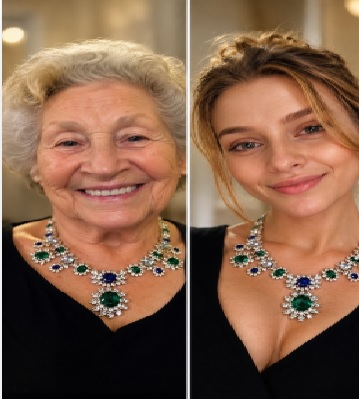
Not a jewelry box.
Not a velvet pouch.
Just a faded blue tin that once held butter cookies, tucked away on the highest shelf of my grandmother’s bedroom closet.
When I was little, I asked her why she kept something so beautiful in such an ordinary place.
She smiled without looking at me.
“Because the things worth protecting don’t always need to be seen.”
At the time, I thought she was talking about the necklace.
Years later, I realized she might have been talking about something else entirely.
My grandmother, Eleanor Brooks, passed away quietly at eighty-six after a brief illness. She raised me after my parents died in a car accident when I was six, and for as long as I could remember, she had been my only family.
After the funeral, I inherited her small house, a mountain of old photographs, several handwritten recipe books, and the mysterious necklace she had worn only twice in my entire life.
It wasn’t flashy.
A silver chain held a deep blue pendant carved from a stone I couldn’t identify. Tiny vines wrapped around its edges, and on the back someone had engraved a single letter.
A.
No surname.
No date.
Just one lonely initial.
Money became tight within a few months.
The roof leaked.
Property taxes arrived.
My old car needed repairs that cost more than it was worth.
I hated the thought of selling anything that had belonged to my grandmother, but practical problems don’t disappear simply because memories are attached to them.
So one rainy Thursday afternoon, I walked into the oldest pawn shop in town.
A brass bell chimed above the door.
The place smelled of polished wood, old books, and machine oil.
Glass display cases held antique watches, coins, cameras, and musical instruments.
Behind the counter stood an elderly man wearing thin glasses.
“What can I help you with today?”
“I’d like to know if this is worth anything.”
I placed the necklace on the counter.
The man picked it up casually.
Then everything changed.
His smile disappeared.
The color drained from his face.
His hands began shaking so badly that he nearly dropped the pendant.
He looked directly into my eyes.
In a whisper barely louder than breathing, he said,
“We’ve been searching for you for twenty years.”
Every instinct told me to grab the necklace and leave.
“I’m sorry?”
He locked the front door.
My heart raced.
“If you’re calling someone, I’m leaving.”
“I’m not calling the police.”
He swallowed hard.
“I’m calling my sister.”
Before I could respond, he disappeared into a back office.
Part of me wanted to run.
Another part needed answers.
Minutes later, an older woman hurried through the rear doorway.
The moment she saw the necklace, tears filled her eyes.
She looked at me as though she had seen a ghost.
“What was your grandmother’s name?”
“Eleanor Brooks.”
The woman covered her mouth.
“Oh my goodness.”
She slowly sat down.
“My name is Margaret Hale.”
She nodded toward the shop owner.
“My brother is Samuel.”
Neither name meant anything to me.
Samuel carefully unlocked a dusty cabinet behind the counter.
From inside, he removed a thick leather folder.
It looked ancient.
Inside were newspaper clippings, photographs, handwritten letters, and one faded picture that stopped me cold.
The woman in the photograph looked exactly like my grandmother.
Only younger.
Standing beside her was another young woman wearing the same necklace.
Margaret pointed.
“That’s my mother.”
“And beside her…”
“Eleanor.”
I stared.
“My grandmother never mentioned your family.”
Margaret nodded sadly.
“She couldn’t.”
“What do you mean?”
She folded her hands.
“Because she promised.”
The story that followed sounded impossible.
In the late 1970s, Eleanor had worked as a nurse in a rural hospital.
One winter evening, a pregnant woman arrived after a devastating highway accident.
She survived only long enough to give birth.
The newborn had no identification.
No known relatives.
Authorities spent months trying to locate family.
Nothing.
Eventually, the baby entered the foster system.
Before she died, the young mother removed the blue pendant from around her neck and placed it in Eleanor’s hand.
“If no one comes…”
“Keep this safe.”
“One day…”
“My child will ask about me.”
Those had been her final words.
Eleanor searched for the baby’s family for years.
She wrote letters.
Placed notices.
Contacted agencies in several states.
Every lead ended the same way.
Nothing.
Meanwhile, the child was adopted by another family.
Records became sealed.
Life moved forward.
Or so everyone believed.
I frowned.
“What does this have to do with me?”
Neither Samuel nor Margaret answered immediately.
Instead, Samuel slid another photograph across the counter.
A tiny infant wrapped in a hospital blanket.
Pinned to the blanket was a handwritten card.
Baby Girl A.
The pendant.
The engraved letter.
A.
I looked from the photograph to the necklace.
Then back again.
“No.”
Margaret’s voice broke.
“We believe…”
“You are that baby.”
The room spun.
“My parents…”
“The couple who raised me…”
“They adopted me?”
Samuel nodded gently.
“They were your legal parents.”
“They loved you.”
“That part never changes.”
I struggled to breathe.
“My grandmother knew?”
“She knew your adoptive parents.”
“When they died, she became your guardian.”
“She honored her promise.”
“She waited until you were old enough to ask.”
“But…”
“You never did.”
I remembered every childhood question.
“Who’s this woman in the picture?”
“Just an old friend.”
“Where did the necklace come from?”
“It belongs to our family.”
She had never lied.
She had simply answered differently than I understood.
For hours we read letters my grandmother had exchanged with Margaret over two decades.
She never stopped trying to discover whether I was happy.
Whether I was healthy.
Whether I was loved.
She wrote after every birthday.
Every graduation.
Every major milestone.
Never revealing my address.
Never violating my privacy.
Only reassuring the woman who had known my birth mother that I was growing into someone kind.
At the very bottom of the folder rested one final envelope.
The handwriting belonged to my grandmother.
Samuel handed it to me.
“She left this with us six months before she passed away.”
The envelope simply read:
For Amelia.
If she ever walks through your door.
Inside was a letter.
My dearest Amelia,
If you’re reading this, then life has unfolded exactly as I hoped.
Not because you found the necklace.
Because you found the truth when you were ready for it.
Families are built in many different ways.
Some are connected by blood.
Others by promises.
Some by choice.
You were loved before you were born.
You were loved after you were orphaned.
You were loved every single day that followed.
Never believe you belonged to no one.
You belonged to everyone who fought to protect your future.
I kept the necklace because it represented hope.
Not secrets.
Hope that one day you would know your story without letting it define you.
Remember this above all else:
The people who raise your heart matter just as much as the people who gave it its first beat.
Love always,
Grandma Eleanor
I cried harder than I had at her funeral.
Not because I had discovered another family.
But because I finally understood how carefully she had carried the weight of someone else’s final wish.
Over the following months, Margaret introduced me to cousins I never knew existed.
They didn’t expect me to replace the family I had lost.
They simply welcomed me into theirs.
We shared photographs.
Recipes.
Stories about my birth mother, Anna—a talented violinist who laughed too loudly and dreamed of becoming a music teacher.
I inherited her eyes.
Apparently, I also inherited her stubbornness.
Today, the necklace hangs in a small glass frame above my desk.
People sometimes ask why I don’t wear something so valuable.
I smile.
Because its worth was never measured in silver or gemstones.
It carried a promise across two decades.
It connected strangers through kindness.
It led me to answers I never knew I needed.
The day I walked into that pawn shop, I thought I was selling the last valuable thing my grandmother had left me.
Instead, I discovered it was the key she had been protecting all along.
And sometimes, the greatest inheritance isn’t money, jewelry, or property.
Sometimes it’s the truth, patiently waiting until the moment you’re finally ready to receive it.